Cooktop Repair
One Burner Sparks and Never Catches: Narrowing It Down
Entered by
Shauna Delacroix
Cooking-appliance technician — gas ignition · 15 years in the trade
The clicking is the igniter doing its job, so she starts where gas and spark are supposed to meet. Nine calls in ten end at a cap seated wrong or an electrode cracked at the ceramic.
Licensed, bonded and insured
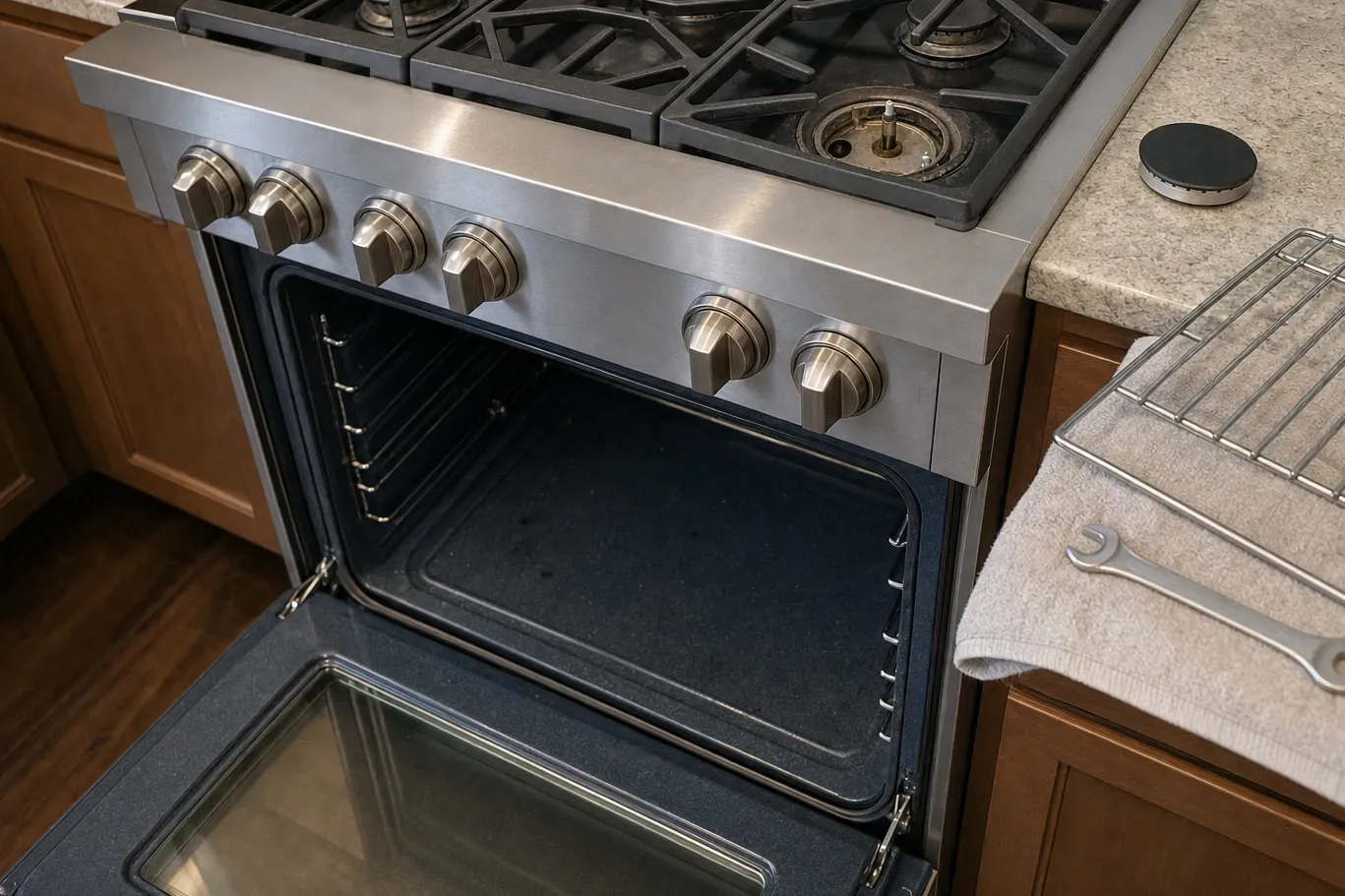
A single burner that clicks and clicks without ever catching, while the three beside it light instantly, is one of the more useful faults a cooktop can hand you. It has already ruled out most of the expensive answers before anyone opens anything, because whatever is wrong is confined to that one burner’s own hardware.
The test that narrows it fastest costs nothing. Turn the burner to light, and if nothing catches within a few seconds, turn it off, let the air clear, and try lighting it with a match instead. What happens next splits the diagnosis in half.
If it lights from a match
Gas is arriving, the valve is opening, and the burner itself is burning. The fault is entirely on the ignition side, and it is one of three things: the electrode, the wiring that reaches it, or the spark module that drives them all.
The electrode is worth looking at first because you can see it. It is the small ceramic-sheathed pin sitting at the edge of the burner head, and it needs a clean gap to the head to jump a spark. Boil-over that has dried into the gap, a hairline crack in the ceramic, or a pin that has been knocked out of position during a clean will all stop it working while the burner remains perfectly capable of lighting.
The second candidate is moisture, and in a city where kitchens run humid through the summer and dry through the heating season it comes up constantly. A damp ceramic conducts, and the spark leaks away instead of arcing across the gap. It looks like a dead igniter and it is not one.
If it does not light from a match either
Then the ignition system is not the problem and the gas side is. That is a different conversation and a shorter one: the port ring may be blocked, the orifice may be partly obstructed, or the valve behind the knob may not be opening properly.
Blocked ports are the benign end of that range. A burner head that has had something boil into it will light unevenly or not at all, and lifting the cap and head off — cold, with the burner off — will usually show you exactly where. The ports are the small slots around the rim, and a blocked one is visible.
What is not a homeowner job is anything past the head. The orifice is a calibrated hole sized for the gas the appliance was set up for, and the valve behind it is part of a sealed gas train. Neither is something to open, adjust or clean with anything that removes metal.
What you can safely do yourself
Everything on this list happens with the burner off and cold.
- Lift the cap and the burner head off, and check they are seated back down on their locating pins rather than sitting proud.
- Look at the electrode for cracks, and at the gap between it and the head for anything dried into it.
- Let a recently cleaned burner dry properly before deciding it has failed.
- Check that the cap is the right one. On a five-burner top they are not always interchangeable, and a swapped pair after a clean will produce exactly this symptom on two burners at once.
That is the whole list. It stops there deliberately: past the burner head you are into the gas train, and the risk of a partly disturbed connection is not proportional to the time it saves.
When it is worth a visit
A burner that lights from a match but never from its own spark is a repair, and usually a small one — an electrode, a lead, or a module. A burner that will not light either way, or one that lights and then burns yellow, lifts off the head or will not hold a simmer, is a gas-side diagnosis and wants pressure measured rather than parts guessed at.
Clicking that carries on after the flame has caught is the one to stop waiting on. It means the control is not registering that the burner is alight, and it will keep sparking indefinitely — into a lit burner — until somebody looks at it.
Follow-ups
- It lights from a match. Does that mean the igniter is dead?
- It means gas is arriving and the valve is opening, which is the useful half of the answer. The spark side is then either the electrode, the wiring to it, or the module driving it. A dead igniter is one of those three and not automatically the most likely — a cracked ceramic or a wet electrode behaves identically and costs a great deal less to put right.
- Is it safe to keep lighting that burner with a match in the meantime?
- If the burner lights normally and burns a clean blue flame once lit, it is doing what it always did — the ignition system is what has stopped. What is not safe is holding a knob open while you hunt for a light, or lighting a burner you cannot see. If gas is on and there is no flame within a few seconds, turn it off and let the room clear.
- Every burner clicks whenever I turn one on. Is that the same fault?
- No, and it is the more informative pattern. Professional cooktops spark all electrodes together by design, so clicking across the top while one burner lights is normal. Clicking that continues after a flame is established is not — that is a switch that is not opening or a module that is not seeing the flame, and it is worth a call rather than a wait.
- I cleaned the burner and now it is worse.
- That is common and usually temporary. Water gets under the cap and into the electrode ceramic, and a damp electrode will spark to the nearest wet path instead of across its gap. Leave the cap and head off, let everything dry properly, seat the head back on its locating pins and try again before assuming anything has failed.